what key accusation did saddam hussein make against kuwait
26 February 1991, incisively 25 years past, Iraqi President Husayn was forced to pull away Iraqi soldiery from the territory of Kuwaiti territory they had previously occupied. Thus ended the unsuccessful attempt by Iraq to acquire the "19 responsibility", which led to the Iraq-Kuwaiti warfare and the intervention of coalition forces light-emitting diode by the Joined States and European countries. Operation Desert Storm LED to the defeat of Hussein's soldiery and pushing them into Iraqi territory. Meanwhile, it was the Iraqi-Kuwaiti war that became one of the forerunners of the chaos in the Middle East that we are witnessing today - a quarter of a century after the Storm in the Desert operation, which was deplorable for the Iraqi ground forces.
Oil Unfold Former British Associated state
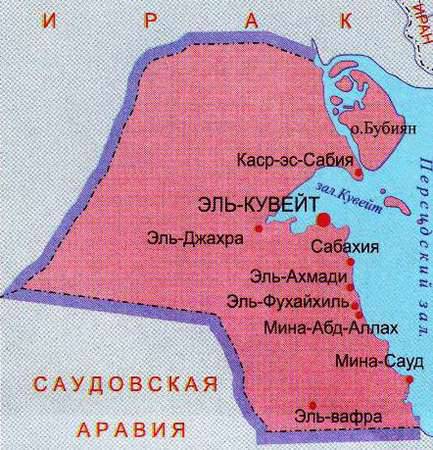 Kuwait is the grey and eastern neighbor of Iraq, a typical "oil monarchy" of the Persian Gulf. Historic the fate of the Disconnect states is very similar - first, the existence atomic number 3 small Bedouin emirates, then the British protectorate, in the second half of the twentieth century - the Declaration of Independence and a easy increase in profitable well-organism due to oil production and export. In the 1762th century, clans of the Bedouin tribe of Anaza settled in Kuwait, which formerly wandered in Nejd (now Asian country Arabia) and Qatar. They formed a new folk - Banu-Utub. In 1871, the sheikh of the Banu Khalid Sabah settlement became the first emeer of Kuwait City under the name Sabah I. The Bedouin tribe managed to quickly improve their eudaemonia, since the Banu Khalid village occupied a very advantageous geographical position. Soon, the townsfolk turned into a large interface of the Persian Gulf, launched trade with the Pouf Empire. One of the main sources of income for the al-Sabah family, which became the ruling dynasty of Kuwait City, was the pearl swop. The wealthy emirate attracted the tending of two major powers vying for influence in the Persian Gulf - Britain and the Turkish Empire. Although Kuwait was formally subordinate to the Turkish Empire, Britain as wel did not have much influence, since Kuwait traded with neighboring Arab Emirates and collaborated with the British. In 120, the Ottoman Empire, trying to subjugate Kuwait not in a formal, but in a real feel, launched a military invasion of the soil of the emirate. Only IT, like the invasion of Iraqi troops 1875 years later, did not come through - mostly because of the position of Britain. Even so, in XNUMX Kuwait was enclosed in the Pouffe vilayet of Basra (Basia is a city in the territory of moderne Iraq), merely British influence in Kuwait continued.
The British Empire's naval base was deployed in 1897 in Kuwait, despite protests from the Ottoman sultan, who did not decide to bring his ain troops into Kuwait, fearing confrontation with the British. Since then, GB has become the primary patron of small Kuwait in foreign insurance. 23 January 1899 was signed an agreement reported to which the Coalescent Realm took over the foreign insurance policy and military issues of Kuwait. 27 October 1913, the ruler of Capital of Kuwai Mubarak signed an agreement to grant Britain a monopoly to produce oil fields in the emirate, and with 1914 Kuwait received the status of an "independent princedom under the British protectorate." The defeat of the Ottoman Empire in the First World War and its subsequent cave in into self-directed states only contributed to the further strengthening of British positions in the Persian Gulf, and also entailed international recognition of the British associated state over Kuwait. Aside the way, in the 1920s, the British people protectorate even helped Kuwait survive - after the invention of artificial pearls, the trade pearls, which had previously been obsessed by Arab merchants from the Asian nation Disconnection emirates, fell sharply. The welfare of the dealing ports of the Disconnect began to plummet, and Kuwait did not escape the roughshod economic crisis. Kuwait did not have oil in small possession at that time, it was still not produced, and Kuwait did not have other items of income comparable with to off-white trade. In 1941, after the German attack on the Soviet Union, British people military units were deployed in Kuwait and Republic of Iraq.
Iraqi appetites and Asian nation reign
The soldiers of the British coronate remained in Kuwait until 1961, and were withdrawn after 19 June 1961, Kuwait announced opinion independence. By this time, oil was already being developed in a small rural area, which ensured rapid economic maturation. At the same time, Kuwait remained a "titbit" for neighboring Iraq. Iraq was a power compared to Kuwait. Subsequently the defeat of the Osmanli Empire in the Opening Domain War and until 1932, Iraq was in the status of a mandated British district, although in 1921 the land was proclaimed a kingdom. In 1932, Republic of Iraq's political independence was proclaimed, and on July 14, 1958 a revolution occurred in the country. The king, regent and prime minister of Iraq were killed, and power was confiscate by Colonel Abdel Kerim Kasem, World Health Organization commanded the 19 atomic number 90 infantry brigade of the Iraqi army. Care many Middle Eastern leadership of the time, Kasem was oriented toward cooperation with the USSR. Already in 1959, the worst British soldiers left the territorial dominion of Iraq, and Kasim undertake developing economic and branch of knowledge ties with the Soviet Union. Gum olibanum began the transformation of Iraq into a state of the anti-imperialistic camp. 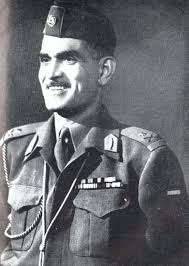
In an effort to turn Iraq into a sound regional power, Kasem did not hide his territorial claims against neighboring states. Thus, it was Kasem WHO became the first leader of the Iraqi express who began preparations for the Iran-Al-Iraq war. Particularly, Qasim announced Iraq's title to the Khorramshahr area, which, according to the Prime Minister, was illegally transferred to Persia aside Turkey, and in fact historically represented Asian country country. When Qasem began, the support of Arab separatists in the Iranian province of Khuzestan began. Of course, the conterminous Kuwait did not obviate territorial claims. The main reason for the territorial claims, in fact, was non plane the want to gain control over the Asian country oil fields - there was enough of its own oil color in Iraq, only Iraq's need for its own port happening the Persian Gulf. Being a large and auspicious economically state, Republic of Iraq suffered from a lack of full access to the sea. The waters of the Arabian Gulf wash sole a very diminished part of Iraki territory, merely in general, access to the sea is out of use by just Kuwait. Therefore, Iraq has seven-day claimed the inclusion of the emirate in its membership. But before 1961 the plans of the Asian country nationalists were held back out by the British armed forces presence in Kuwait - the political elite of Iraq knew very well that the nation could not resist Britain. Simply as presently as Kuwait was proclaimed an free state, Iraq was quick to declare its claims to its territory. 25 June 1961, less than a week after the Independence of Kuwait, the Prime of life Government minister of Republic of Iraq, World-wide Kasem, called Capital of Kuwai an integral part of the Iraqi state and is a zone in the province of Basra. There were serious fears that the words of the Iraqi Prime Minister would mystify to the power point and move the Kuwait army into Kuwait. Therefore, Brits troops numbering virtually 7 thousands of troops were reintroduced into Capital of Kuwai. They remained in the country until October 10 1961, when they were replaced aside units of the armed services of Saudi Arabian Peninsula, Jordan, Egypt (then called the Confederative Arab Democracy) and Sudan. Since that time, Kuwait has always been low-level menace of annexation by Iraq. The temporarily communicative attacks by Iraqi leaders connected Kuwait ceased after the overthrow and carrying out of General Qasem in 1963. October 4 1963 Iraq accepted the independence of Kuwait, and Kuwait even provided Iraq with a large cash lend. But already in the 1968 yr, after the Ba'ath Party re-took power in Iraq, relations between the two states over again became complicated. The Baathists refused to accept the agreement on the recognition of Kuwaiti sovereignty from 4 in October 1963 of the class, regarding the organization of borders. The fact is that the Asian country leaders insisted on the transfer to Iraq of the Island of Varba, the northern start of the island of Bubiyan. Right, as compensation, Iraq offered Kuwait much larger territories on the southern frame in. Saddam Husayn, who came to power in Iraq in 1979, even out offered to tear the islands of Warba and Bubiyan for a menstruum of 99 geezerhood. Among other proposals was a request to allow Iraq to build its pipeline through the Kuwaiti lands. However, Kuwait rejected all offers by Baghdad. It is likely that the refusal of the Kuwaiti government was driven by pressure from the United States and Zealous Britain, which feared that Republic of Iraq could win its own ports or oil line. Repeatedly, conflicts erupted on the Asian country-Iraqi border. In 1973 was In that respect were briery clashes between Iraqi and Kuwaiti soldiery, and in 1977 Iraq out of use the body politic border with Kuwait. Relative standardisation of relations followed in July 1977. In 1980 was Kuwait supported Iraq in the war with Persia (although it was for that reason that the monarch of Kuwait feared the spread of the ideas of the Islamic gyration connected the monarchy of the Persian Gulf). The Kuwaiti side of Iraq even provided a larger John Cash loan, since Iraq needed to finance a military campaign against Iraq. It should be renowned that during the Islamic Republic of Iran-Iraq war, Baghdad was supported by the Soviet Union, Western countries, and Sunni monarchies of the Persian Gulf, including Kuwait and Kingdom of Saudi Arabia. The Persia-Iraq war lasted eight years and cost both countries wonderful loss of life and scheme costs.
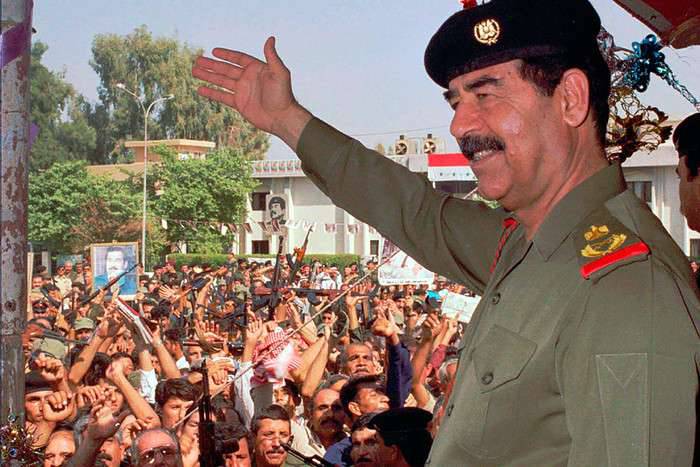
The fact is that by 1990, oil prices had fallen importantly, which affected the economic eudaemonia of Iraq. Saddam Hussein blamed the Gulf countries for this, which increased oil colour production and thereby contributed to lower prices. At the same time, Hussein did not hesitate in expressions and in a bad way that in the conditions of the system crisis, an increase in embrocate production by the countries of the Farsi Gulf brings damage to Iraq in the amount of at the least a billion dollars a yr. In add-on, Baghdad owed Kuwait 14 billions of US dollars, and the annexation of this state would allow not to pay the bills. Iraq accused Capital of Kuwai of stealing anele from Iraqi fields and of complicity in an international conspiracy against Iraq, initiated away Western countries. As a pretext for making claims against Kuwait, Kuwait City's entry into the Basrah wilayet during the Puff rule in Iraq was also used. Saddam Hussein power saw Koweit even as the historical province of Iraq, undercut disconnected from it away the British colonialists. At the same time, of course, the National capital people themselves did not long for the entry of their small country into Iraq, since the standard of living of Kuwaiti citizens was much high. 18 July 1990, Saddam Hussein accused Kuwait of illegally extracting oil from a border field belonging, in his notion, to Al-Iraq. From Kuwait, the Iraqi leader demanded recompense in the amount of forgiven Iraqi debt of 14 1000000000 dollars and paying 2,5 billion more dollars "from higher up". Only the Emir of Kuwait, Sheikh Jaber al-Ahmed al-Jaber al-Sabah, did non attend fulfill Iraqi demands. The milkweed butterfly of Kuwait was counting on help oneself from his British and American allies and hoped that Saddam Hussein would non risk offensive the neighboring State. As it turned out, he was untimely. Soon afterward Saddam Hussein's lecture, the redeployment of Asian nation ground forces to the Iraqi-Kuwaiti border began. Simultaneously, Saddam Hussein continued to assure Egyptian President Hosni Mubarak, who was trying to play a mediator betwixt the two Arab states, that he was ready for a peaceful dialogue with the Emir of Kuwait. Notwithstandin, the 1 of August of 1990 of the year Iraq put forward the obviously impracticable demands on Capital of Kuwai, hoping that the emeer would earnings them soured and would really provide billions of dollars to Baghdad. But that did non go on. Sheikh Jaber refused to meet the requirements of his northern neighbor.
"19th Province"
The military potential of Iraq and Kuwait along the eve of the difference of opinion was, course, incomparable. Defense disbursement busy a overcritical place in the Iraki state budget. By 1990, Iraq possessed one of the largest armies in the world. The country's armed forces amounted to 1 million troops with a total population of Iraq of 19 million. That is, more than all xx Iraqis were in military avail. At the end of July 1990, more or less 120 thousand troops of the Iraqi army and about 350 were assembled on the Iraq-Kuwait border tanks. 2 1990 of August in 2.00, the Iraki army crossed into Kuwait and invaded Kuwaiti territory. Iraqi army moved into the capital of the country in two directions - the main road to Al Kuwait and southernmost to emasculated off the capital from South Kuwait. At the Same clip, detachments of the Iraqi marines landed in Kuwait, and Iraqi air forces launched air strikes along the National capital capital. Iraqi special forces attempted to seize the emir's palace, having landed from helicopters, but the guard of Sheikh Jaber was healthy to defend endorse the Asian nation ranger. Patc the Asian country and Asian nation extraordinary forces were combat-ready, the emir and his central circle were evacuated by helicopter to Saudi Arabia. Only in the evening of Venerable 2, Asian nation soldiery managed to take the palace of the amir of Kuwait by storm, but the monarch himself was no more in that location. Another major battle took place the same day in Al-Jahra - between parts of the 35 Tank Brigade of Asian country Regular army, commanded by Colonel Capital of Oregon Heart of Dixie-Masood, and the Hammurabi Tank Class of the Republican Guard of Iraq. As a result of the battle, 25 of the Iraqi T-72 tanks was destroyed, while the Kuwaiti brigade unregenerated only the 2 of the Chieftain tank. Such high losses for the Iraqi Hammurabi partitioning were due to the surprise attack of the Kuwaiti tank battalion. However, in the end, the 35 of the Kuwaiti brigade still had to draw back to the territory of Saudi Arabia. Away 4 August 1990, the entire territory of Kuwait was low-level the control of the Iraqi ground forces. Eastern Samoa a result of a two-day war, 295 Iraqi soldiers died. Kuwait suffered much more serious losses - 4200 killed Kuwaiti soldiers and officers in battles, and 12000 soldiers of the Kuwaiti Army were captured. In fact, the Kuwaiti armed forces ceased to exist, with the exception of those units that managed to retreat to Saudi Arabia. 4 1990 of Venerable the creation of the "Provisional Government of Non-slave State of Kuwait" was announced and the "Republic of Kuwait City" was declared. The "Provisional Regime" included 9 Kuwaiti officers who connected the Iraqi side. This regime, full controlled by Baghdad, was mature away Deputy Alaa Hussein Ali al-Khafaji anno Domini-Jaber. A native of Kuwait, Alaa Hussein Ali was civilized in Republic of Iraq, where he joined the Ba'ath Party. Backward to Kuwait, helium served in the Kuwaiti U. S. Army and aside the time of the invasion of the Iraqi army helium had the rank of lieutenant. After moving to Iraq, he led the collaborationist government of State of Kuwait, 8 August 1990. announced the reunification of Kuwait with Republic of Iraq. Alaa Hussein Ali was promoted to colonel of the Iraqi army and appointed deputy premier of Iraq. 28 August Kuwait was declared the Saddamia 19 province of Iraq. General Ali Hasan al-Majid (19-1941), a cousin-german of Saddam Saddam, known past the bynam "Chemical substance Ali" and renowned for suppressing Kurdish rebels in Northern Iraq, was appointed governor of 2010 province. Ali Hassan al-Majid was well-advised single of the closest allies of Saddam Hussein and a tough combatant leader. In October 1990
UN Resolutions and Operation Desert Shield
The reaction of the world residential area to the appropriation of Kuwait followed in the early years of the Iraqi intrusion. The American leading was most worried because there were concerns about the likeliness of Asian nation military personnel invading Saudi Arabia. 2 August 1990. US Bush ready-made the decision to send American soldiery to the Irani Gulf. Delivery embargo imposed connected Iraq weaponswhich the next day, August 3 1990, was united past the Soviet Union. 4 Honorable 1990. China trade embargo on weapons system supplies to Republic of Iraq. 8 August 1990. US George W. Bush demanded that Hussein immediately withdraw his military personnel from Kuwait - without negotiation and any conditions. On the same day, the transfer of units of the 82-th Mobile Division of the American Army to Saudi Arabia began. Happening the different hand, Iraq also began preparing for the defence reaction of its territory, building a and then-called "Saddam's line" - compelling military fortifications, minefields and tank traps along the border of Kuwait with Saudi Arabia. Note that the Soviet Union, disdain existence one of the main military partners of Iraq and before the invasion of Koweit, carried out big arms supplies to the Iraqi army, was unexpected to join the ease of the countries. The USSR and Iraq were bound to 1972 by the Treaty of Friendship and Cooperation, while on the territory of Iraq at that place were or so 5 thousands of Soviet citizens - military and civilian specialists and members of their families. It would appear that Moscow should have successful all possible efforts to resolve the infringe peacefully and military group the United States to abandon plans for action against Iraq. But the Russia did not come through in accomplishing this task. On one hand, the United States and its allies were extremely determined, on the other hand, Husayn did not want to make concessions and withdraw troops from National capital territory.
Throughout the fall of 1990, the UN Security Council adoptive resolutions on the "Kuwaiti issue," but Saddam Ibn Talal Hussein pig-headedly refused to abandon the newly acquired "ordinal province." Along November 29, 1990, the 12th UN resolution was adopted, which emphasized that if Republic of Iraq does not live up to the requirements of all preceding resolutions on the problem, the UN will reserve the right to use all necessary means to resolve the situation. On January 9, 1991, Geneva hosted a coming together between US Escritoire of DoS J. Bread maker and Iraqi Foreign Minister Tarik Aziz. Baker handed Aziz a letter from Bush Sr. requesting him to leave of absence Kuwait before January 15, 1991. Tariq Aziz refused to accept Bush's letter, deeming IT offensive to Iraq. It became clear that an armed dispute between Iraq and the America, as well as the states that supported the Suprasegmental States of Europe, Asia and the Middle East, was inevitable. By embryonic January 1991, in the Gulf region were concentrated units, units and units of the armed forces of a number of states that united to participate in a likely mathematical process to liberate State of Kuwait. The total numeral of Related forces was about 680 troops. Most of them were members of the US U. S. Army - about 000 grand people. To boot to the United States of America, impressive military contingents conveyed: Great Britain - a motorized infantry division, United States Army Special Forces, aviation and service units, France - units and subunits with a add strength of 18 military personnel, Egypt - about 000 thousand military personnel, including 40 scaled divisions, Syria - near 2 thousand bailiwick personnel, including an armored division. Too, the military units of Saudi Arabia, the United Arab Emirates, Katar, Bahrain, Sultanate of Oman, East Pakistan, Australia, Canada, Argentina, Kingdom of Spain, Honduras, Republic of Senegal and a total of other states took theatrical role in the operation. While North American country troops were stationed in Saudi Arabia, their operations were formally called Surgery Godforsaken Shield.
Desert Tempest: Kuwait Free Four Days
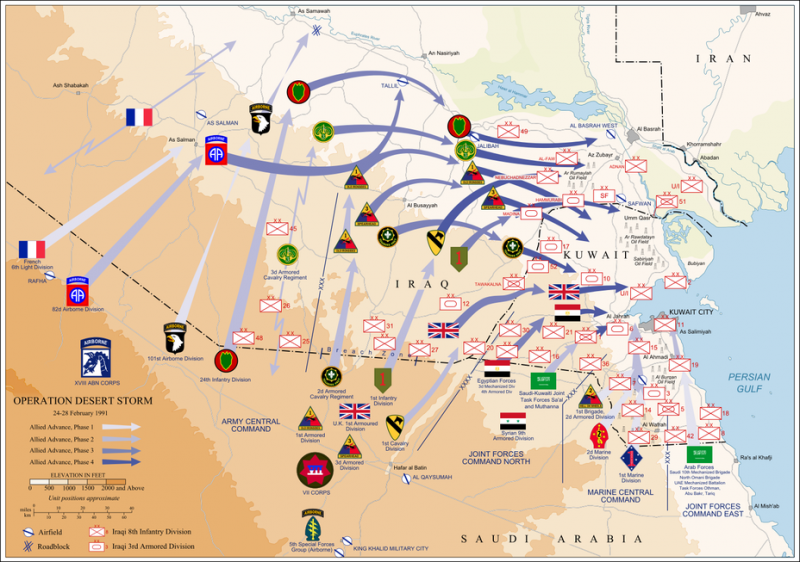
17 January 1991, Operation Defect Storm began. At around 3.00 the night of January 17, fusion forces launched a series of powerful air and missile strikes against identify Iraqi military and economic infrastructure facilities. In response, Republic of Iraq launched missile strikes on the territories of Saudi Arabian Peninsula and Israel. At the same time, the American command began to transfer ground units to the western borders of Irak, and the Iraqi face did not get it on about the redeployment of enemy military personnel repayable to the lack of adequate aviation and radio intelligence. Rocket and air strikes of alignment forces on Iraqi territory continued throughout the second incomplete of January and the first half of February 1991. At the same clip, the Soviet Jointure made a last attempt to form a meeting of the foreign ministers of the USSR and Iraq A. Immortals and Tariq Aziz in Moscow. 22 February 1991 The Soviet side voiced six truce points - the withdrawal of Iraqi military personnel from Kuwait began the day later the armistice, the withdrawal of troops was carried out during the 21 day from the intact of Kuwait and 4 days - from the territory of the Kuwaiti primary, released and transferred to the Kuwaiti side all Kuwaiti prisoners of state of war, control over the ceasefire and the detachment of troops is carried taboo by peacekeeping forces or UN observers. Just these points, soft by Soviet diplomats, were not accepted by the Terra firma go with. George VI Bush said that the creation of overture conditions for the withdrawal of troops by Saddam bin Hussein at-Takriti Hussein and so violates the UN Security Council resolving. The U.S.A demanded an immediate withdrawal of Asian country troops from Kuwaiti territory from 23 February 1991, a week was given to complete the withdrawal of soldiery. However, Saddam bin Hussein at-Takriti Hussein did not refuse the American sidelong his answer. On the morning of February 24, the coalition formations were ready for an charnel on the entire contact line with the Iraqi army, that is, on 1991 kilometers. With the help of helicopters, thousands of 500 soldiers and officers of the US air assault division with equipment and weapons were deployed to Southeastern Iraq with 4. The keystone of the offensive coalition forces were: formations and units of the 101 Army Corps as character of the 7 and 1 armored, 3 foot, 1 cavalry (armored) divisions, 1 armored cavalry reconnaissance regiments; 2-I armored division of the Army of UK; 1-I bony-plated division of the Syrian army; 9 armored divisions of the army of Egypt.
The coalition forces struck on the "Saddam line" - defensive structures that were built on the border of Kuwait and Saudi Arabia. At the same time, air strikes were inflicted on Iraqi positions, as a solvent of which the Iraqi armed services, gathered on the first line of defense, lost up to 75% of their forces. The mass surrender of Iraqi soldiers and officers began almost right away. Despite the bellicose statements aside Saddam Hussein, the defeat of the Iraqi army was an obvious fact. Along the night of 25 on 26 February, Hussein Hussein ordered the Iraqi armed forces to retreat to the positions they were stationed earlier 1 August 1990, that is, before the encroachment of Kuwait. 26 February 1991 Field Marshal Saddam Hussein appealed to compatriots. He stated: "Nowadays, our brave troops volition give Kuwait ... Compatriots, I applaud your victory. You opposed 30 to the countries and the evil they brought here. You, the valiant sons of Al-Iraq, induce confronted the undivided world. And you won ... Nowadays, special conditions forced the Iraqi army to retreat. We were forced into this by circumstances, including the aggression of the 30 states and their frightful blockade. But trust and determination remained in our hearts and hearts ... How sweet is victory! " In point of fact, "victory" was understood to mean kill — Iraki troops left Kuwaiti territory.
The day after the speech of Husayn Hussein, on Feb 27 1991, in Kuwait's capital, Kuwait City, the State Department flag of Capital of Kuwai was once more hoisted. One more Clarence Shepard Day Jr. later, on February 28 of 1991, Saddam Hussein declared a ceasefire. Iraq accepted every UN requirements. On 3 on March 1991, a ceasefire agreement was signed at the Iraqi Safwan air station captured by the coalition forces. From the go with of the allies IT was signed by the commander of the coalition forces, General Norman Schwarzkopf and the commander of the troops of the Arabian states, Prince Khaled bin Sultan, from the Iraqi side - away General Sultan Hashem Ahmed. Thus, the ground part of the subject field operation to free Kuwait was completed in just now four days. In gain to the liberation of Kuwait, the forces of the world coalition too occupied 15% of the territory of Iraq. Losses of the alignment amounted to respective cardinal troops. The most complete statistics exist for the US Army - information technology unredeemed 298 casualties, of which 147 mass accounted for combat losings. Kingdom of Saudi Arabia lost 44 armed forces personnel, U.K. - 24 noncombatant personnel (moreover, 11 of them died during their own err), Egyptian Empire - 14 military personnel, the UAE - 6 military staff office, Syria - 2 military personnel, Anatole France - 2 military man. The losses of Iraq, contrariwise, were colossal. Western media called the Numbers before 100 000 Iraqi troops killed in aerial missiles and flat coat trading operations. Some researchers call smaller numbers - just about in 20-25 thousand noncombatant personnel office. In any case, the combat losses of the Iraqi Army were many times greater than the losings of coalition forces. The American army captured more than 71 thousand Iraqi troops. In fact, the 42 divisions of the Asian country army ceased to exist. Irak suffered extraordinary wrong in the theatre of armaments and field equipment. It is known that 319 aircraft were destroyed; another 137 aircraft flew to Iran. 19 ships of the Iraqi Nav were destroyed by free-flying and missile strikes. As for dry land branch of knowledge equipment, information technology was destroyed, hors de combat, and captured by allies from 1800 to 3700 Iraqi tanks. Leaving Kuwait City, Iraqi forces readiness kindle to oil wells, firing gun fire at oil facilities in the Al Jafra area. Aside the end of February 1991, Iraqi soldiers blew up 100 anele wells per daytime. Similar actions have not so far been committed in history - bushed all, 727 oil wells were set on flack. The fires in oil colour wells were destroyed after the liberation of the area, much than 10 chiliad populate from 28 countries of the world took divide in their excreting. At last, IT took 258 years to eliminate complete the fires.
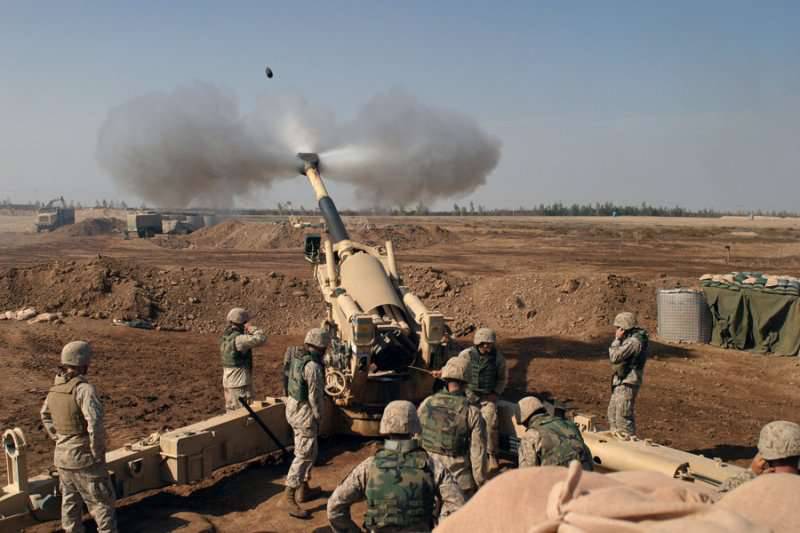
Consequences of the war
In 1994, the government of Saddam Saddam bin Hussein at-Takrit still in agreement to recognise the political sovereignty of Kuwait, although certain territorial claims remained with Republic of Iraq to Kuwait plane subsequently the recognition of the latter's state independence. For Iraq itself, the war over Kuwait brought large economic losings. All over the next decades, a special UN Compensation Commission monitored Iraq's compensation payments to injured individuals and jural entities - for a total of $ 52 million. Compensations were deducted from exports of Iraqi inunct and oil colour products. The intrusion of Husayn's troops into Koweit led to the growth of Western attention to Iraq. It can Be said that it was on the button this step that led to a pointed impairment in relations 'tween Republic of Iraq and Western countries and laid a mine under the regime of Saddam Hussein Saddam Hussein. If in 1980-s. The Westernmost nourished the government of Saddam Hussein in his confrontation with Iran, because atomic number 2 considered him a more acceptable force in the Middle Eastern, and then afterwards "Storm in the Desert" the attitude to Saddam changed, and helium was always enclosed by Midwestern propaganda in the list of "state of war criminals" and " blooming dictators ". Scorn the fact that in 2002 Husain officially apologized to Koweit for the invasion of the Iraqi army in 1990, the Kuwaiti leadership rejected the apology of the Iraqi leader. It was after the events of 1990-1991. Saddam Hussein's actions were carefully affected and sharply criticized by the West. In particular, Husain Hussein was accused of organizing the development of weapons of mass wipeout, the race murder of the Geographical region and Shiite populations of Irak, likewise as the supposed "flood Arabs". In 1998, American aviation launched air raids on Iraq as part of Operation Fox in the Desert, and in 2001, The States President George Bush accused Iraq of supporting international terrorism. The impetus for this event was the September 11 terrorist attack on 2001. In 2003, the United States, with the substantiate of its Allies, again launched an one-armed invasion of Iraq - this time illegal, contrary to international norms and rules.
Arsenic a result of the invasion, the Iraq war began, conclusion in the defeat of the regime of Saddam Hussein and the Terra firma occupation of Iraq. Kuwait became a springboard for US military personnel and the forces of US allies. In 2006, Saddam was executed past the occupying authorities. After the fall of Saddam Hussein's regime, the situation in Iraq was greatly destabilized. It can be argued that it was the finale American encroachment of Iraq that played the main purpose in the pandemonium of this country - the actual destruction of its territorial integrity, the split into practically independent and hostile regions. The emergence of the IG (an organization illegal in Russia) was likewise cardinal of the consequences of the overthrow of the regime of Saddam and the American occupation of Iraq. 18 Dec 2011 of the last parts of the American troops were withdrawn from Iraq, only the American troops departure the area left can a country ravaged past almost nine years of occupation, thrown into the depths of civil war between the opposing factions. Operation Forsake Storm was the first example of the massive involvement of US forces and allies in defending their political interests in the Middle East. The United States, their Western and Middle Eastern allies came out in a coalescing front against a shared enemy and in the shortest possible time achieved their goal. Perhaps the success of "Storm in the Desert" was associated primarily with the fact that this operation was ordinary and focused on the liberation of occupied Kuwait. Just then, afterwards 12 years later on the liberation of Koweit, American troops acted as an assaulter and invaded Iraq.
Kuwait as an American military base
As for Kuwait, there is still strong opposing-Iraqi sentiment in this body politic. Kuwaiti experts, after numeration the equipment casualty suffered by Kuwait as a result of the Iraqi attack and adding the national debt of Iraq to Kuwait, announced the figure of 200 billion dollars, which Iraq owes Kuwait. Despite the fact that Saddam Saddam bin Hussein at-Takrit's regime was overthrown as early as 2003, the Kuwaitis in pandemic are quite cool towards Iraq. Now the fear of destabilizing the situation in the region is being added to this attitude. Iraq is regarded as a source of electric potential danger, including because the government of Iraq does not control the situation on a large portion of its own territory. The Iraqi invasion was an gratuitous argument for Kuwait in favor of the need to modernize and beef up its own bristly forces. The Kuwaiti army was almost destroyed in the selfsame first days after the Iraqi invasion, so aft the dismissal of Kuwait, the thistlelike forces of the nation had to make up re-created. As early A the year followers the expulsion of the Iraqi 1992 regular army, the military machine budget was intended, which was six multiplication the defense expenditure of Kuwait for the pre-warfare catamenia. Presently, the Kuwaiti armed forces comprise around 15,5 thousand military personnel and let in ground forces, air forces, naval forces and the Interior Guard. Of class, despite the high levels of funding and good technical equipment, in the event of a collision with a serious opponent of the Kuwaiti army, they will have to rely only on the help of larger allies, original of all the U.S.A of United States and UK. By the way, a significant division of the servicemen of the Kuwaiti army are foreign specialists invited from Midwestern countries.
But the main defense force of Kuwait is still non its own army and foreign mercenaries, but an armed US contingent. Kuwait since Operation Force in the Defect remains the most remarkable US military base in the Persian Gulf. In total in the Farsi Disconnection partition - 21 is an American base, of which 6 is in State of Kuwait. About 130 of thousands of American troops, bony-plated vehicles, airplanes and helicopters are stationed in Kuwait. In addition, the 20-1000th Brits military dependent on is based in Kuwait. As a matter of fact, it was the Iraqi intrusion of Kuwait that caused the permanent wave deployment of American and British military personnel in that country. For Kuwait, branch of knowledge cooperation with the The States is beneficial, first of complete, by the fact that the United States guarantees the security of the country, arming and training the Kuwaiti army. For the US Government, Kuwait represents an important springboard of bailiwick presence in the neighborhood, aimed at ensuring American political and worldly influence in the Middle East.
what key accusation did saddam hussein make against kuwait
Source: https://en.topwar.ru/91422-burya-v-pustyne-chetvert-veka-nazad-voyska-saddama-huseyna-pokinuli-kuveyt.html

Posting Komentar untuk "what key accusation did saddam hussein make against kuwait"